
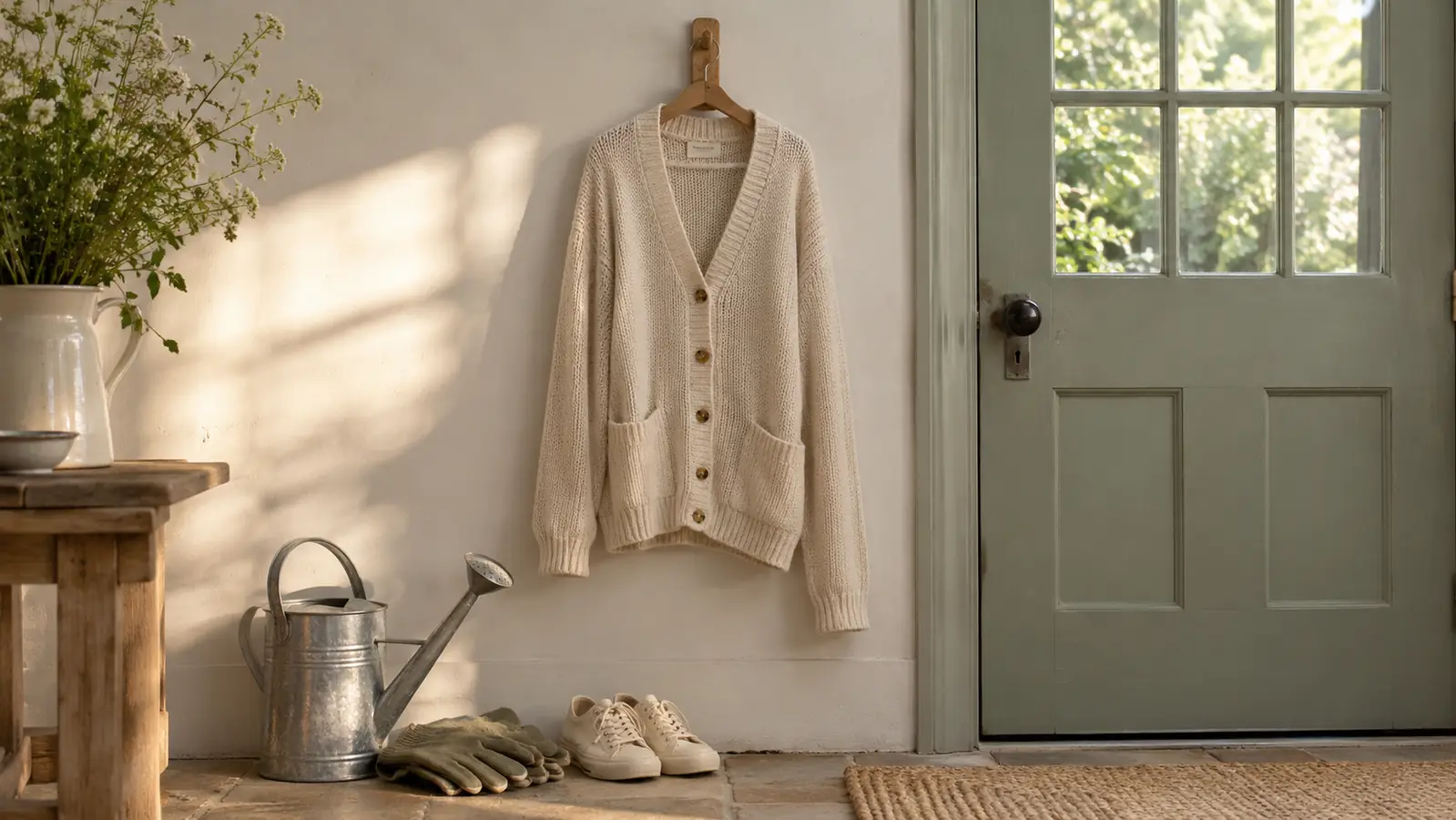
The garden is a different climate at seven in the morning than it is at ten. You step out to cut back the roses in fifty-eight degrees with dew on everything, and by the time you have filled the watering can twice the sun is over the fence and you are carrying your sweater instead of wearing it. I have handled this the same way for years, and it is not complicated. I layer. The cardigan that lives on a hook by my back door is a PRETTYGARDEN open front cardigan, and it earns that hook because it goes on and comes off without me setting anything down.
What I used to do was worse. I would put on a fleece jacket, be too warm by nine, and spend the rest of the morning with it tied around my waist while I deadheaded the zinnias. Or I would wear a heavy pullover, have to come back inside to change, and turn a twenty-minute garden job into an hour of walking back and forth through the house. A robe is not the answer either, not if the mail carrier comes up the walk. What follows is the five-step version of what I actually do now, in the order I do it, from the layer closest to my skin outward.
One Layer That Goes On And Off With Dirty Hands
The PRETTYGARDEN open front cardigan is the piece I keep by the back door for cool mornings and warm afternoons. Loose knit, long sleeves, and nothing to unbutton while you are holding a trowel.
Amazon Check Today's Price on Amazon →Step 1: Start With The Layer That Touches Your Skin
The cardigan is not the layer that decides whether you are comfortable out there. The shirt under it is. This one is a knit blend, 72% polyester, 24% acrylic and 4% elastane, and a blend like that holds warmth well without drying the way plain cotton does. If I put it over a synthetic top and start sweating at nine, I feel clammy until I go in and change. Over a cotton tank or a cotton tee, the same morning feels fine.
So the rule is simple. Above sixty degrees when I walk out, I wear a cotton tank under it. Below sixty, a light long-sleeve tee. Both are thin enough that the cardigan still hangs the way it is meant to. When I layer over something thick, like a chunky sweatshirt, the whole thing bunches at the shoulder and the sleeves fight me every time I reach for a branch. The knit is made to sit over a smooth, thin layer, and that is how it looks best.
One more thing about the base layer: keep it plain. The cardigan is a solid knit with no pattern to hide behind, so a busy print underneath shows at the neckline and at the cuffs and makes the outfit look like three separate decisions. I wear white, cream or a soft blue tank under mine, and the whole thing reads as one outfit instead of a pile of clothes.

Step 2: Match The Knit To The Hour, Not The Forecast
The forecast is for the day. You are dressing for the hour, and that distinction is the entire reason this cardigan works for me from March through November. The listing puts it in fall, spring and winter. I would add cool summer mornings to that list, because the knit is warm enough for dew and open enough that it does not cook you once the sun clears the treeline.
If you are going out at seven and staying until ten, dress for nine. That means a lighter base and the cardigan worn open. If you are going out at seven and back inside by eight, dress for seven: cardigan pulled closed in front with one hand while you work, sleeves down. I keep a heavier layer inside the door for the rare mornings that start in the forties, but I do not wear that one into the garden. I wear it to the mailbox and back. The PRETTYGARDEN knit covers more of my year than any jacket I own, which is the whole argument for keeping it by the door instead of in a closet.
Damp is the other thing to plan around. A knit is not a raincoat. If the hydrangeas are still wet and I push through them, the shoulders take on moisture and stay cool against me for a while. I do the wet work first now, before the cardigan goes on, or I wear it open and keep my arms clear of the soaked leaves. It dries quickly enough on the hook, but it does not feel good while it is wet, and a knit that stays damp all morning is a knit you end up taking off.
Step 3: Use The Open Front As Your Thermostat
This cardigan has no buttons, no zipper and no tie. It is open front, full stop. For some people that is a deal breaker. For gardening it is the reason I bought it. There is nothing to unfasten when your hands are muddy, nothing to pull at when you are holding a bundle of spent rose canes, and nothing to snag on a branch when you walk past the hydrangeas.
In practice you get three settings out of it. Worn open, it hangs at your sides and lets air move through. Pulled closed in front with one forearm while you stand still reading a seed packet, it holds more warmth than you would expect, because the cut is loose and the two fronts overlap easily. Pushed back off the shoulders, it stays put on your upper arms and gives you ten cool minutes while you finish pruning. That last one sounds fussy and it is not. It is what everybody does with a cardigan anyway.
The regular fit matters here too. It is cut loose enough that pulling the fronts together does not strain across the back, which is the exact problem I have had with tighter open cardigans that look fine standing still and pull the moment you bend over a bed. I am not built like the model in the listing photo and I do not need to be. I want something I can kneel down in.
Three settings and no hardware: worn open, pulled closed with one forearm, or pushed back off the shoulders. That is more control than any zip-up I own.
Step 4: Deal With The Sleeves And The Neckline Before You Get Wet
Long sleeves and a garden hose do not get along. Cuffs are the first thing to get soaked and the first thing to look tired. I push my sleeves up to just below the elbow before I turn the water on, and I push rather than roll, because a rolled cuff on a loose knit slides back down within a minute of reaching for anything. Pushed up and left alone, they stay where I put them.
The neckline is a crew neck, which sits close and plain at the collarbone. That is the right shape for this kind of work. A wide neck falls forward every time you bend over a bed, and then you are standing up and hauling it back into place with a fistful of soil. A crew neck stays put. If the morning turns out colder than the forecast promised, that is where a scarf earns its keep, tied loose at the throat. It is an addition, not part of the cardigan.
One habit worth building: check the cuffs before you come inside. A loose knit picks up bits of leaf and a little grit, and if you sit down on the couch in the same cardigan, that grit ends up on the cushion. I brush mine off at the door with the flat of my hand and hang it up. Ten seconds, and the cardigan stays something I am willing to wear to the store.
Step 5: Plan The Peel-Off Before You Leave The Yard
The best part of layering is not the layering. It is the moment you take the top layer off and are still dressed. This is where the PRETTYGARDEN cardigan beats a jacket for me every time. A jacket has to be hung somewhere or folded over the back of a chair, and once it is off it still looks like outerwear sitting there. A cardigan taken off over a cotton tank and a pair of jeans looks like a woman in a tank top, not a woman who has abandoned her coat in the kitchen.
So before I go out, I decide the whole outfit and not just the top half. Jeans or linen trousers, a clean tank, and the cardigan over it. Then when I come in from the garden at ten, I knock the soil off my shoes, wash my hands, pick up my bag and drive to the grocery store in the same clothes. Nobody at the checkout knows I have been on my knees in the zinnias. That is the test I actually care about, more than how anything looks on a hanger.
The thing I do change is the shoes. Garden clogs stay at the back door, always. And if I have been kneeling in damp soil, my knees and the front of my trousers are the giveaway, not the cardigan. A quick look in the hall mirror before I walk out catches it. I keep a damp cloth by the door too, for the occasional leaf print on a sleeve.
What Else Helps
Washing matters more than people expect with a knit like this. I wash mine on cold with the rest of my everyday clothes, then either line dry it or tumble it on low for a few minutes and hang it while it is still slightly damp. The 4% elastane is what brings the shape back after a wash, and heat is what wears it out. A hot dryer will change how a loose knit hangs within a single season. Cold water and low heat, and mine has come out of the wash looking the way it did in the first month.
Two small things. First, keep the cardigan where you use it. Mine lives on a hook by the back door, not folded in a drawer upstairs, because a layer you have to go find is a layer you will not wear. Second, buy it for the fit you actually want. The listing calls it oversized, but the cut is regular and the feel is loose, which means it will not swallow you like a coat. If you are after a big draping wrap-around sweater, this is a lighter thing than that. I like the weight for exactly that reason, and it helps to know before you order.
If you want the longer version of how this one has held up after repeat washing, there is a full long-term review that goes into the knit, the cuffs and the sizing in more detail. There is also a side-by-side against a fleece jacket, which is worth reading if your mornings start cold enough that a single knit will not do the job.
The Layer That Lives By My Back Door
Open front, long sleeves, crew neck, loose knit and no hardware to fight with. Check the current price and the size chart before you order, since the fit runs relaxed.
Amazon Check Today's Price on Amazon →